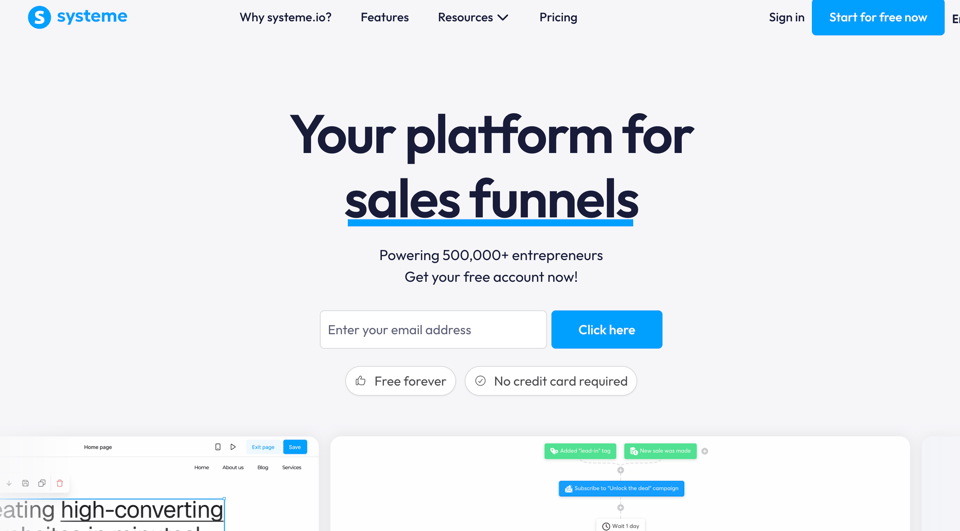
If you sell courses, coaching, memberships or digital products online, you have almost certainly run into both names. Kajabi has the polished marketing, the big-name creators and the premium price tag. Systeme.io has the free plan, the loyal community of budget-smart entrepreneurs and a reputation for doing a surprising amount for very little money.
This guide compares them honestly on pricing, features, ease of use, courses, email, funnels, automation, fees, support and who each platform really fits. The platform is built around one simple promise: you should not need a stack of five subscriptions just to sell one course.
Pricing Comparison
Money first, because it is the easiest thing to compare fairly. There is a 14-day free trial. Here is what the limits look like: Extra contacts can be added in blocks of 25,000 for $125 a month. Annual billing saves up to about 16.7 percent on paid plans, which works out to roughly $170, $470 and $970 a year. Here is what stands out: Contact, funnel, domain and automation limits rise as you move up the plans and can change over time, so check the live pricing page before you commit.
Let us run the math over a full year, using the prices above. Look at those numbers side by side. The top Systeme.io plan, billed annually at about $970, is still roughly $746 cheaper than Kajabi’s cheapest plan billed annually. Compared with Kajabi Pro on annual billing, you would save close to $3,800 a year. And compare the entry points. A beginner on Kajabi Basic with monthly billing pays $2,148 in year one, while a beginner on Systeme.io Startup pays $204. That is a gap of nearly $1,950, which is more than many new creators spend on their entire first launch.
Feature Set and User Experience
To be fair, Kajabi has a refined interface, guided setup and a lot of hand-holding. Its dashboard looks modern, and the course and coaching builders are tidy. If you want a premium, smooth experience and are willing to pay for it, that is a real selling point. Systeme.io’s interface is plainer. It is not trying to win design awards. It is organized around the actions you want to take: build a funnel, write an email, create a course, set up a product, launch an affiliate program. Menus are straightforward, and templates give you a starting point so you are never staring at a blank page.
Because everything sits in one dashboard, a motivated beginner can have a working funnel live in a day or two. That speed matters. The creators who succeed are usually the ones who launch quickly, learn from real visitors and improve. The ones who struggle are often still polishing their setup months later.
Who Each Platform Fits
Systeme.io assumes you are working toward [revenue]. If your goal is to reach your first funnel, your first subscribers and your first sale, there is no logical reason to begin at $179 a month when you can start free with Systeme.io and upgrade only when your revenue asks for it. Kajabi assumes you are already making money. If you want a polished experience and are willing to pay for it, that is a real selling point.
Extra contacts can be added in blocks of 25,000 for $125 a month. Advanced automations, the affiliate program and the removal of Kajabi branding start at the Growth plan. The branded app, API access and code editing sit on the Pro plan.
Annual billing saves up to about 16.7 percent on paid plans, which works out to roughly $170, $470 and $970 a year. Contact, funnel, domain and automation limits rise as you move up the plans and can change over time, so check the live pricing page before you commit. You can see current numbers inside Systeme.io.
If your goal is to reach your first funnel, your first subscribers and your first sale, there is no logical reason to begin at $179 a month when you can start free with Systeme.io and upgrade only when your revenue asks for it. Kajabi positions itself as a done-for-you business platform, and it does feel more refined in several areas. That polish has a cost, and the cost is not small.
You can look inside right now by opening a free Systeme.io account. No payment is needed to start.
Originally reported by Buttondown.