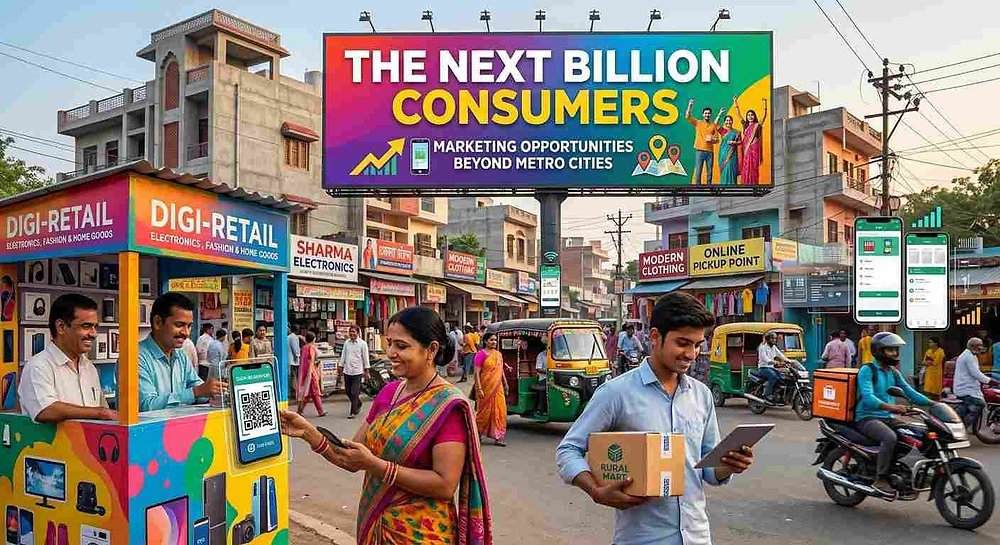
India’s internet base has moved decisively past its metro-city origins. According to the Internet in India Report 2024, published jointly by the Internet and Mobile Association of India (IAMAI) and Kantar, the country had 886 million active internet users in 2024, an 8% year-on-year increase, with the user base projected to cross 900 million in 2025.
Of this base, 488 million users, or 55%, were located in rural India, and rural internet adoption was growing at roughly double the rate of urban adoption. The same report found that 98% of users accessed content in Indic languages, that women constituted 47% of all internet users (the highest share recorded to date), and that while urban users led in digital payments and net commerce, rural users led in OTT video, music streaming, and social media use. Mobile remained the dominant access device across both geographies.
The Value Commerce Landscape Emerges
This shift created a structural opportunity: a consumer base large enough, and now digitally reachable enough, to reward companies that could profitably serve Tier 2, Tier 3, and Tier 4 towns rather than treating them as an afterthought to metro operations. The Indian e-commerce sector responded with a distinct category often described as “value commerce,” positioned against the premium, brand-led commerce associated with the metro-first platforms.
Three players came to define this category. Meesho, founded in 2015, built its entire model around non-metro and low-income consumers from inception. Flipkart launched Shopsy in mid-2021 specifically to reach “tens of thousands of low-income shoppers in Tier 2-3 towns” through a zero-commission marketplace model, according to statements made by Flipkart senior vice-president Adarsh Menon and reported in the business press. Amazon followed in April 2024 with Amazon Bazaar, a marketplace offering affordable, largely unbranded products across lifestyle and home categories.
Company Strategies in the Tier 2-4 Push
By the mid-2020s, Meesho, Shopsy, and Amazon Bazaar were competing directly for the same cohort of first-time and value-conscious digital shoppers in smaller Indian towns, each disclosing its own non-metro traction figures through press statements and media interviews, though these figures use different definitions and are not independently audited or directly comparable across companies.
Meesho’s Foundational Non-Metro Model
Meesho did not begin as the platform it is known as today. According to the company’s own published account, Vidit Aatrey and Sanjeev Barnwal founded the venture in July 2015 under the name Fashnear, initially envisioned as a hyperlocal fashion platform modelled on food and grocery delivery: local stores in Bengaluru’s Koramangala and HSR Layout neighbourhoods would list products, and customers would receive several items at home, keep what they liked, and return the rest.
This model did not work, in the company’s account, because the offline stores involved were primarily interested in running end-of-season clearance sales rather than ongoing hyperlocal retail, and customers cared more about discounts than about local sourcing. The pivot came from an unplanned insight: the founders observed a shop owner in Koramangala selling products through WhatsApp and Facebook groups. This led to a new product, “Meri Shop” (shortened to Meesho), which let small shopkeepers move their businesses online with auto-stocking and inventory management; roughly 10,000 shops signed up within about six months of this version’s launch, per the company.
In running this product, the founders discovered that the most active sellers on the platform were not shopkeepers at all but women reselling products from home, without holding any inventory themselves they would curate photos of products from suppliers and only place an order with the supplier once a customer had committed to buying. Meesho restructured itself around this behaviour, positioning the company as a bridge connecting suppliers directly to a distributed network of individual resellers, and launched the “Meesho Supply” app with cash-on-delivery, returns handling, and seller support built in. The two apps ran in parallel for roughly nine months before the company began charging commission and consolidated around Meesho Supply, which became the Meesho app used today. This origin matters to the case because it means Meesho’s non-metro orientation was not a diversification strategy layered onto an existing metro business, as it was for Flipkart and Amazon; it was the foundational model from which the company never needed to pivot away.
Related reading
Originally reported by MarkHub24.
1 thought on “India’s Internet Base Surpasses 886 Million With Rural Growth Outpacing Urban”